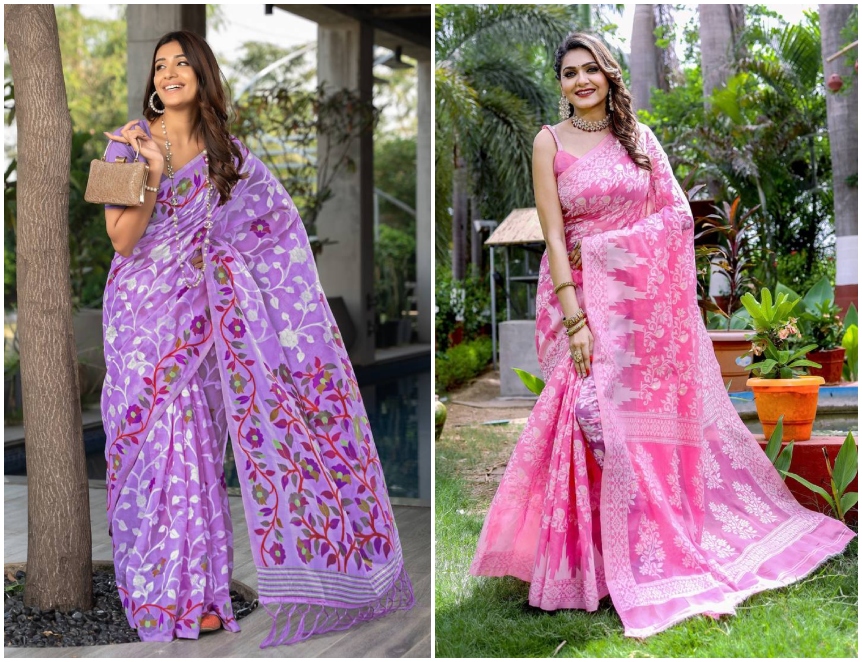
Indian weaving is most definitely an art form. And a Jamdani saree is just that. It is a beautiful saree laden with elegance and motifs. It is the pride of West Bengal. Art of fabric making in India reached its pinnacle under the rule of Mughal emperor Akbar, when Jamdani, a muslin decorated with flowers, took on a life of its own. In fact, even the name Jamdani is Persian in origin and derives from the words “stick” for bloom and “Dani” for vase. The name of the saree alludes to its exquisite flower designs.
With British colonization came a decline in the production of this material. One of the primary causes of Jamdani’s decline in the nineteenth century was British imports of cheaper yarn. Similar to this, the makers of Jamdani were denied assistance from their most ardent fans as the Mughal era in India came to an end. Towns like Jangalbadi and Madhurapur, previously well-known for their astounding Jamdani industry, vanished into obscurity. Indian fine art began when many weavers went to West Bengal to exhibit their work.
Jamdani is hailed as the most sophisticated hand weaving technique in the world because of its complex designs, which are all carefully applied by hand. This is what makes this fabric so distinctive. Each design must be incorporated into the fabric by weaving fine warp threads with denser threads.
Types of Jamdani Sarees
Dhakai Jamdani
This is the original and most widely used style of Jamdani saree among Bengali women. The exquisite craftsmanship on this saree is extremely enchanting. A single saree may take the weavers 9 months to a year to weave. The bright colors of these sarees are widely acclaimed. They are also somewhat transparent and lightweight, yet in the most gorgeous way.
Shantipur Jamdani
This jamdani saree is woven in Shantipur, West Bengal. They have sophisticated striped motifs and patterns all over the saree.
Tangail Jamdani Sarees
The Tangail area of Bangladesh is where this style of Jamdani is woven. The saree has broad borders and designs of lamps, lotuses, and fish scales. The only distinction between Tangail and Shantipur sarees is in the motifs. This Jamdani saree features traditional embroidery with large and little flowers, fish motifs, and other designs.
Dhaniakali Jamdani Sarees
It is made in West Bengal’s Dhaniakhali. Bold hues and dark, contrasting borders are used to create this style of jamdani saree. Compared to the earlier variety of dhakai jamdani sarees, they have a much tighter texture. These sarees are typically found in deeper shades with some contrasting border colors.
Styling a Jamdani Saree
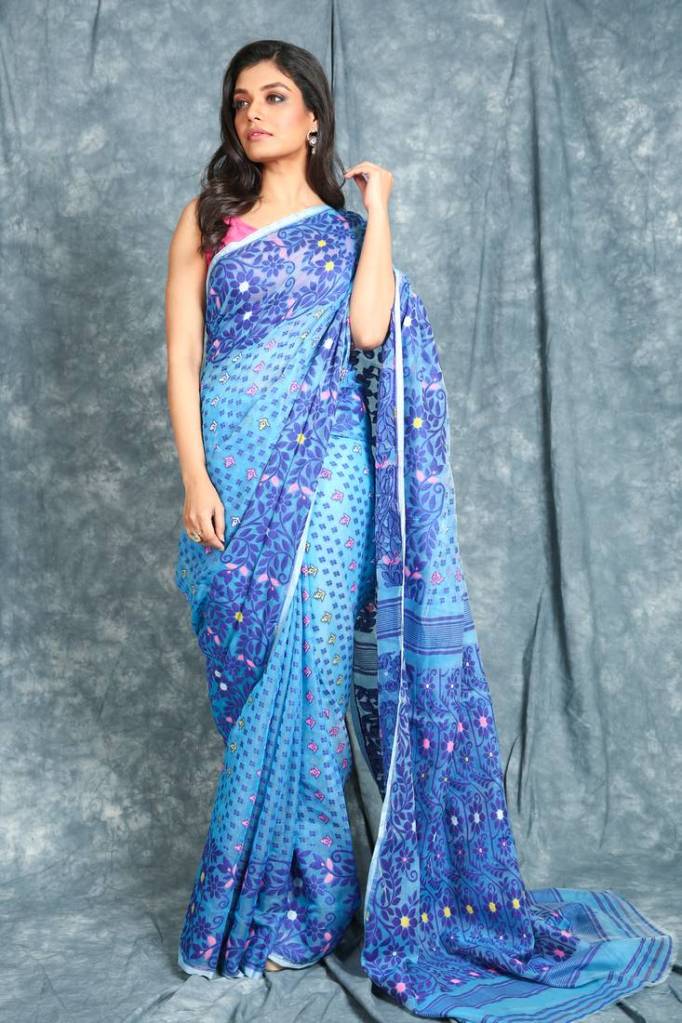
Many people from various age groups bring the Dhakai Jamdani saree to West Bengal. Some of these sarees have contrasting colors for both the body and border, which appeals to younger people more. These Jamdani sarees are incredibly comfortable to wear in all seasons and may even be worn to a casual-chic party because of their fine texture and appealing smoothness. Jamdani sarees have a subtle, elegant aura that pairs beautifully with unusual ethnic jewelry. While plain silver or gold jewelry looks best with formal wear sarees, items like oxidized necklaces, terracotta, and dokra jewelry sets look fantastic with casual variations.
Instead of the traditional ethnic themes, the most recent iterations of these sarees have a variety of intriguing modern designs. For instance, tie and dye borders give the saree a vivid feel and offer a striking alternative to the traditional single-color borders. Modern designs, such as geometric patterns, abstract artwork, and stylized animals and flowers, are also present.
Buying Sarees on Mirraw
Mirraw boasts of a grand collection of Dhakai Jamdani sarees in a variety of colors, designs, and fabrics.
 Fashion for Life
Leave a comment