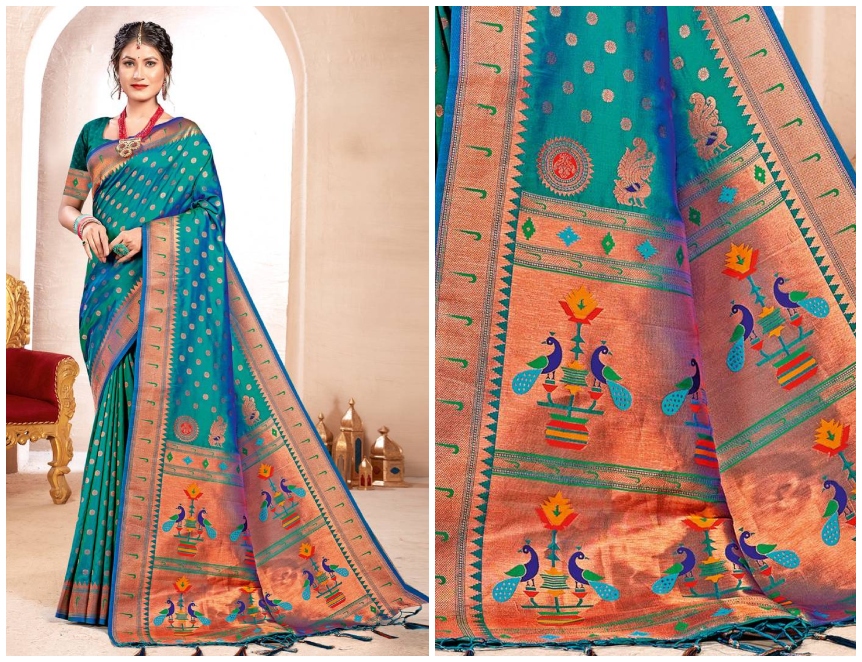
Paithani sarees holds a special place in every woman’s heart. It is a unique variety of silk saree that is woven by hands. It is made of natural silk and weaved along with precious metal threads like gold and silver, this Indian sarees give the touch of Midas. And the motifs in particular, set Paithani above all other traditional fabrics, as it bears special significance of true Indian philosophy of living in harmony with nature and its elements. However, it is the only textile that unites every elements of life together in the form of blessings and protection to the wearer. Paithani sarees are often said to be hand woven poems in gold and silk.
The technique of tapestry practised to make Paithani silk sarees, use multiple wefts and warp threads of varied colours and arts with golden and silver threads or zari weaved together to form an amazing piece of silk saree. Paithani sarees are becoming an iconic art of India with its gaining popularity and demand dissolving borders of religion and geography. Paithani sarees also carries the cultural legacy of Maharashtra that has a special meaning in the life of women, who form the pillars of every family and society. It is also known by the name of Queen of Silks since it was previously only worn by royals and aristocrats.
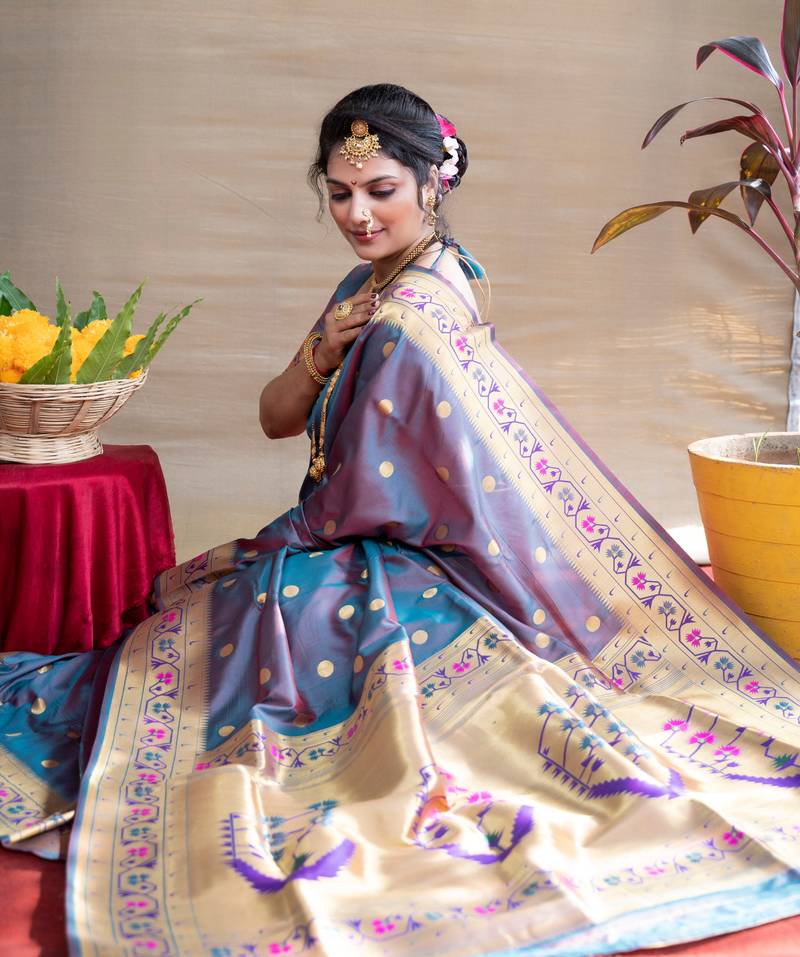
Among all other Indian saree Paithani is regarded as the best because of its unique designs and patterns. They are weaved in six and nine yards unlike any other saree. They also specialize in the feature of exactly same looking sides. In fact, the pallu and the border also looks exactly the same. It is also noteworthy that these sarees do not lose their shine and lustre till ages even after washing them for many years. Also it is important to know that paithanis never wear out at the folds unlike many other silk sarees. The most common, prominent and interesting designs that feature in the pallu and borders are namely the lotus, peacock, flowers, fan, coconut, bangle, mango, parrot, other musical instruments etc.
Origin and History of Paithani Saree
The term Paithani comes from the name of the Paithan town in the city of Aurangabad. Paithan town is situated in the Maharashtra region of India. Paithani sarees have originated during the Satvahana Dynasty almost 2000 years ago at around 200 BCE by the banks of the divine Godavari river which later progressed throughout the Deccan region. There are many stories that go ear to ear about the making of the saris with fine threads of gold and silver during the era of primeval period.
Paithani sarees rose to popularity in a very less time due to its rich look, colour, texture and intricate designs. But it reached its peak mainly during the time of the Mughals. During the Mughal period the emperors and queens preferred wearing paithani sarees made of gold and silver threads. But unfortunately, with the beginning of the British rule and the Industrial Revolution there was a big decline in the weaving industry that was the core of the making of paithani sarees. However, the crafts were not entirely lost until in the 17th century the Peshwas decided to actively promote the craftsmanship. It is since then that the fabric again got its life back.
 Fashion for Life
Leave a comment